Inviting young people to have fun and get involved in the work of California Wildlife Center (CWC)- dedicated to emergency rescue, rehabilitation, and release of injured, abandoned or sick native wildlife and marine mammals. Learn how you can help our native wildlife!
CWC's Youth Wildlife Rescue Blog invites young people to have fun and get involved with the work of California Wildlife Center whose mission is to rescue, rehabilitate, and release injured, abandoned or sick native wildlife and marine mammals from the greater Los Angeles area. Come and get involved yourself or with your school and help our local wildlife. The Wildlife Center has taken in 19,000+ wild animals since its opening in 1998 and relies solely on public donations and grants. CWC is located in a quiet part of the Santa Monica mountains in Calabasas. Please visit our website at www.californiawildlifecenter.org for more information. We look forward to hearing from you on this blog!
CWC WILDLIFE NEWS, ALERTS and UPDATES - November 19, 2011
We have a brand new website! Check it out! www.cawildlife.org It's awesome!!!
Check out some of our Fall rescues and patients!
Our Grey squirrels are finally rehabbed! See there release below!
Check out Charlie, the elephant seal pups rescue and release back into the wild!
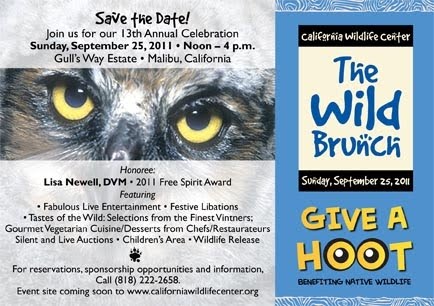
Thank all of you who attended our 13th Annual Wild Brunch fundraiser in September at Gulls Way Estate in Malibu! It was a huge success because of you!
Check out our first, ever Big Free-tailed bat!
Our November 2010 Coyote rehab and release video is finally done. Check it out in our new posts section below. The video of our 5 rehabbed fawns is also up.
Thank you to everyone that turned out for our Wild Brunch on August 22nd. It was a smashing success! Check out Mike Hayward's photos of the event.
News briefs: See a pelican get rescued! We're having a Pelican party in our ICU...first black-coat elephant seal ever rescued by CWC...First marine mammal rescue in SoCal for 2010...Yearling sea lion rescued at Pt. Dume! Update on our rescued fox from Culver City! We have another Youth Rescue blog hero! .DON'T TRIM THAT TREE - baby birds and squirrels are nesting now! Watch the CBS report here...HAVE FUN! HELP THE ANIMALS! EARN COMMUNITY SERVICE CREDITS! Organize a fund-raising event at your school! Contact our youth team with your good (even crazy!) ideas at rescuecwc@california wildlife center.org...
-Ruddy Duck -Western Grey Squirrel that came in abandoned -Northern Fulmar; very rare in Malibu -Infant Pied-billed grebe -Western Tanager -Awesome Osprey -290 lb male California sea lion suffering from malnutrition -Burrowing owl that was abandoned -A Brandt's cormorant getting a tube feeding of fluids -Tiny Canada Goose that was the size of a Mallard -A Bobcat with severe mange -230 lb female California sea lion suffering from domoic acid toxicity and leptospirosis
The western grey was considered one of the most abundant mammals in the northwest in the 1920s, but by the 1930s an epidemic outbreak of mange decimated many populations in Washington. While the eastern grey and the eastern fox squirrels are capable of producing more offspring in times of abundance to compensate for population loss in lean times, the western grey appears unable to do so, thus limiting its ability to rebound from low populations. Additionally, unlike its eastern cousins, which breed twice a year, the western grey has one litter a year, with between three and five young per litter. They are shy squirrels, who are dependent upon older mixed forests with a variety of oak and pine or oak and fir trees with interconnected tree canopies for food, cover, nesting sites, and arboreal travel. These squirrels generally nest in the top third of larger trees, building leaf and twig nests called drays, which they line with lichen, moss and bark shavings. They often build more than one nest, and alternate among them.
Favorite foods are pine nuts, acorns, nuts, berries, fungi, green vegetation and insects. The animals are generally non-territorial, but show a dominance hierarchy at food sites.
Western grays are a federal Species of Concern, but are not listed as threatened or endangered. Oregon considers them a State Sensitive Species, and Washington state considers them State Threatened. They are still hunted in California and Oregon. Conservation groups in Washington state have petitioned the federal government to provide an emergency listing for this species. Only time will tell whether these efforts will be sufficient to preserve this squirrel.
These two little guys experienced a bad fall from their nest and were brought in for our help. Months later, they are being released back into the wild. Enjoy!
This is Charlie, a baby Northern Elephant seal. He was rescued on March 25, 2011 when a concerned citizen, Erik Cooper, called us about him. He was at Leo Carillo beach and thought Charlie had died. We reassured him that elephant seals sleep very soundly and not to worry. We asked him if he could stay with the animal until we arrived to keep people and dogs away from him. He happily obliged and even helped us rescue him. We found Charlie to be very lethargic, underweight and dehydrated. Thanks to Erik, Charlie was rescued and transported to the Marine Mammal Care Center for rehab. The staff there took very good care of him and much to everyone's joy, Charlie was released back into the wild on July 13, 2011. He weighed a mere 75 lbs when rescued and a very healthy 198 lbs. when he was released! Have a great life Charlie!!!
These are some of the patients we are rehabilitating now. The first is a screech owl. The Western Screech Owl is a small, nocturnal, woodland Owl of western North America and is one of the west's more common owls at lower elevations. They are squat-looking owls that sit erect, with their plumage fluffed out, with the feet and legs obscured, and distinct ear tufts raised. The iris is bright yellow and the bill is gray to black, with tufts of bristly feathers around its base. The facial disk is bordered by black. The toes are yellow. Feathers are either mainly grayish or reddish-brown variegated dark and light, resembling a furrowed tree bark pattern. They use the variegated plumage as camouflage. When threatened, the bird stretches its body and tightens its feathers in order to look like a branch stub to avoid detection, but will take flight when it knows it has been detected.
The second picture is a female mallard duck. She was rescued from a shopping mall in Valencia. Her right leg was fractured and caused her to limp. Dr. Tom was able to put a "walking boot" type splint on it and she is doing well.
The third group of birds is Western Scrub Jay babies. Western scrub-jays are common through the American West, from the California coast through Oregon, southern Idaho, Nevada, Utah, Colorado, New Mexico, Arizona and parts of Texas, mostly in lowland areas with oak and pinyon pine trees. The birds easily adapt to urban and suburban areas and are popular visitors to backyard feeders. Western scrub-jays do not migrate.
The fourth picture is of kestrels. Perhaps the most colorful raptor in the world, the American Kestrel is the most common falcon in North America. It is found from Alaska to Tierra del Fuego, and in towns as well as wild lands.
We've been busy at the Wildlife Center! This little Guadalupe fur seal was very tiny when she was found. Her mom may have been chased into the water by people or dogs. When you see marine mammals on the beach, it's best not to approach them and call someone who can help them. Our hotline number 310-458-WILD.
Our baby skunk is making herself at home until she gets big enough for release. This is her cute end. You definitely wouldn't want to see the stinky end!
Our red-lored parrot, Meg was a victim of domestic violence. Her owners were charged with animal abuse. Our vet, Dr. Tom adopted her and brings her to the Center with him so we can all enjoy her.
This juvenile great horned owl is also doing very well. He's eating lots of mice!
This adult, female sea lion was rescued from Zuma beach. She was very skinny and didn't look like she was feeling very well. She also had an orange tag on her right, front flipper which means she has been in rehab before. The number on it told us she was released from the Care Center in Ft. MacArthur in November of 2010. We're hoping she does better this time around.
Last, but not least, this mama opossum and her five babies are getting ready to be released. By the time you read this, they will once again be free in the wild. This is the most rewarding part of our jobs at the Wildlife Center and a joy to witness!
On January 3, 2011, the California Wildlife Center got a very interesting rescue call. A family living in a high rise apartment building in Santa Monica had noticed a large bat on the outside of their 14th story window screen. It had been there for a few days and they were worried something was wrong. They called CWC and a team responded and rescued it. It was a Big Free-tailed bat (nyctinomops macrotis). Our first at CWC!
Big free-tailed bats roost mainly in crevices and rocks in cliff situations, although there is some documentation of roosts in buildings, caves, and tree cavities. Their weight ranges from 25-30 grams (ours was 16g upon arrival) and they have a wingspan of 17-18 inches. They are a seasonal migrant and a powerful flyer. Their only known doucmented predator is the owl. They forage almost entirely on large moths, but some data exists to document occasional foraging on other insects, including grasshoppers, beetles, crickets, leafhoppers, stinkbugs and flying ants.
Our bat did very well and was released back into the wild in Orange County closer to his kind.
Join us for an afternoon of… Entertainment • Wildlife Education • Children’s Activities CWC’s Fall Open House Sunday, October 3, 2010 Noon – 4 p.m 26026 Piuma Road, Calabasas, CA 91302 Most activities will be outside, so please dress accordingly. Refreshments Served • Free Admission • Children Welcome RSVP: email Admin@californiawildlifecenter.org or (818) 222-2658
Meet the Staff: Ask the Marine Mammal Response Team about why seals and sea lions “strand” themselves on the beach and what you can do to help. Ask our Hospital Techs and Volunteers about how to recognize a fledgling bird… one that should be left alone and not kidnapped. Ask Dr. Tom about his most unusual wildlife cases.
Guided Tours: View an informative video followed by a tour of the Center led by one of our knowledgeable volunteers. Visit the intensive care hospital and the Baby Care Unit.
Children’s Activities: Animal face-painting and visor decorating; learn how to build an easy bird feeder.
Grab your parents and head out to Zuma beach for a fun time in the sun and you can do something really great for the environment too! Every year, the California Coastal Commission sponsors coastal cleanups on beaches up and down the California coast. Last year, over 80,000 people helped out! You will be AMAZED at how much trash people leave on our beautiful beaches. It harms the environment, the ocean and the animals that live in and around it. Hope to see you at the beach! For information about volunteering with us, contact jeff@californiawildlifecenter.org
On July 25, 2010,the California Wildlife Center received a very large and unexpected visitor. The State Department of Fish and Game brought a 250-pound brown bear that they had captured in someone’s backyard. It had an injury to its leg, which they wanted the center’s veterinarian, Dr. Duane Tom, to evaluate and treat. Dr. Tom was more than happy to help them out. The patient did very well and was later released back into the wild.
Photos courtesy of the California Wildlife Center by Gayle Uyehara
CWC started taking in rabies vector species. These are animals that can carry the rabies virus without showing any of the typical symptoms. It is important to handle these animals with caution.Our staff and volunteers that work with them (skunks, bats, coyotes, foxes, etc.) have to get pre-rabies vaccines prior to any contact with them. No one likes getting shots, but we think it's totally worth it! See for yourself! They are quite charming and adorable!
Please come and join us for a beautiful day at an amazing estate in Malibu!
California Wildlife Center is hosting Fawntasia at Gull's Way Estate on Pacific Coast Highway from 12 noon to 4pm. There will be a special childrens buffet, face painting, activities and some really cool snakes to play with! Don't miss the fun. We will also be releasing a rehabbed hawk after dessert. It's definitely something that you don't want to miss!
We have helped over 22,000 animals in our history of wildlife rehabilitation. You can help us to continue to help thousands more, by purchasing tickets.
The recent storms and treacherous surf have wreaked havoc on the seabird population. Just in the month of January, CWC has admitted 29 California Brown Pelicans and is expecting more in the coming days. Most of the birds are suffering from hypothermia (they get very cold). Their feathers normally form a natural barrier to the water and act as insulation from the cold, but instead are matted by oil, grease and other substances from the massive runoff, much of it coming from roads and freeways. We had already received many pelicans prior to the storms that were emaciated from not finding food. The El Nino condition is causing water surface temperatures to rise, sending fish out to deeper, colder water. The storms dealt them a second blow. Our staff and volunteers are working very hard to stabilize them which requires warming them up and hydrating them. Once stabilized, they are transported to IBRRC (International Bird Rescue Research Center) in San Pedro for rehabilitation. They have received 107 pelicans and counting. It takes 5 to 7 days per bird before they can be released back into the wild.
Our Marine Mammal team rescued our first EVER black-coat elephant seal pup today! This approximately three weeks old pup should still be on the beach with her mother on one of the Channel Islands. However, last weeks storms and incredibly rough surf likely washed her out to sea where she was carried by the currents (she doesn't swim well yet) to our shores. She crash landed on the rocks at Leo Carillo State Beach and has numerous cuts, bruises and bumps. The "black-coat" refers to the curly black coat that all elephant seals are born with and that is shed shortly after weaning to reveal their normal brownish-silver pelage. She was transported to the Marine Mammal Care Center in San Pedro this morning. Her prognosis is guarded because she is so young, but we will all be keeping our fingers crossed for her!
This female yearling sea lion looked like a baby she was so small. She's actually about one and a half years old and should weigh about 90 lbs. We observed her for 2 days and realized she hadn't made any effort to go out and hunt for food because she was in exactly the same place both days. It seemed she had just given up. Food sources have been hard to find for all the younger sea lions this year because of the warmer water surface temperatures. The fish move out to deeper, colder water and the small sea lions can't go that far. Upon assessment, she was very underweight (43 lbs.), dehydrated, lethargic and had a bloated stomach. We made the decision to make a rescue attempt, even though she was in a very tough place to get into and out of. After more than an hour of climbing over rocks, the rescue was complete. She was transferred to the Marine Mammal Care Center in San Pedro for medical assistance and rehabilitation. Her first week was pretty tough, but she is now eating on her own and gaining weight. If all continues to go well, she will be returning to the ocean soon with a second chance at life! Go Whitney!
RELEASE ALERTS! Watch this space for upcoming release information
RELEASED AND HOME! This is Charlie. He was rescued on March 25, 2011. He was released back into the wild on July 13th. Read Charlie's story under our Posts section!
Our 5 rehabbed fawns were released in November, 3 at the California Wildlife Center and 2 in San Diego County. The videos are up in our Post section. Check them out!
WHAT TO DO IF YOU FIND AN ANIMAL THAT NEEDS HELP
DON'T TOUCH! The first rule, if you see an injured animal or bird, is not to go near or touch it. Immediately get an adult to help you. They can read our guidelines on how to help different birds and animals here. Or they can call : Emergency Hotline: 310-458-WILD(9453) OR CALL THE CWC HOSPITAL ON 818 591 9453
HOW YOU CAN HELP OUR NATIVE WILDLIFE
California Wildlife Center runs entirely on public donations, and needs your help to keep it's hospital and Baby Care Unit going. You can help by: - Being part of our youth fundraising team drawn from schools around the area. Contact rescuecwc@californiawildlifecenter.org if you are interested in getting involved. - Contributing items from our wish list, things the animals need to help their recovery. You can find them here (Baby care wish list) - Creating a fun event at your school or club to raise funds for CWC. Some ideas include holding a car wash, lemonade stands, organize a school-wide collection of needed items, picnic's, rummage sales, runs and walks. If you have an idea and want to get started, contact our youth Fundraising team on admin@cawildlife.org
Ducklings Ahoy!
These little ducklings have found a cosy spot on a gentle pair of hands to set them on their way after they became separated from their mother. Once they get older, and able to look after themselves, they will be taken back to where they were found, and released.